Search Poetry

Showing posts with label Masnavi Rumi 1 - (1 مثنوی رومیؒ). Show all posts

(Masnavi Book 1: 70 Book Complete) The unworldliness of the Prophet ﷺ


Explaining that the motive of the Prophet, on whom be peace, in seeking to conquer Mecca and other (places) than Mecca was not love of worldly dominion, inasmuch as he has said “This world is a carcase,” but that on the contrary it was by the command (of God).


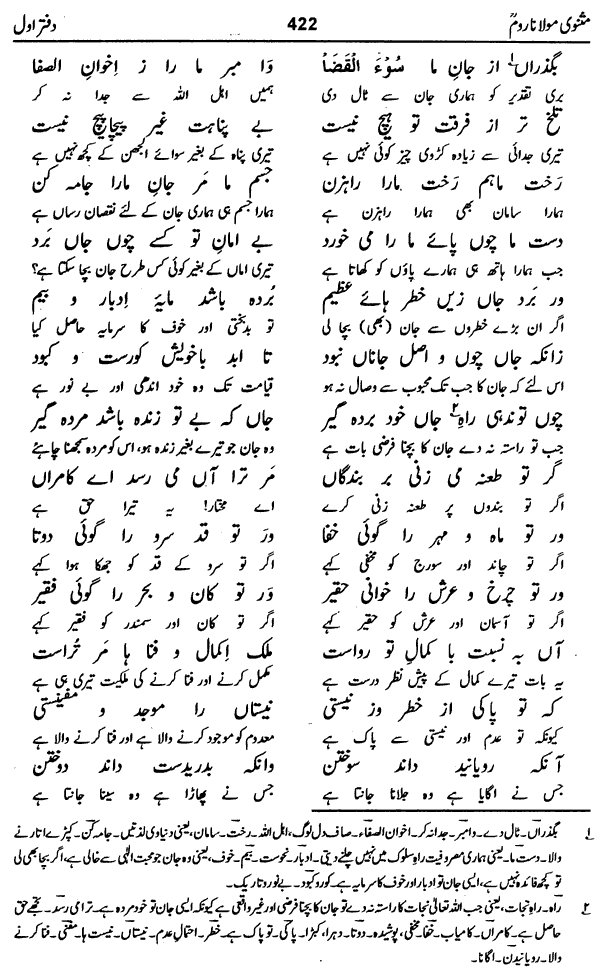
Likewise the Prophet's struggle to conquer Mecca—how can he be suspected of (being inspired by) love of this world? He who on the day of trial shut his eyes and heart to the treasury of the Seven Heavens,


3950. (When) the horizons of all the Seven Heavens were full of houris and genies (who had come) to gaze upon him, Having arrayed themselves for his sake—how indeed should he care for anything except the Beloved?
He had become so filled with magnification of God, that even those nearest to God would find no way (of intruding) there.

“In Us (in Our unity) is no room for a prophet sent as an apostle, nor yet for the Angels or the Spirit. Do ye, therefore, understand!”

He (also) said, “We are má zágh (that is, Our eye did not rove), we are not (looking for carrion) like crows (zágh); We are intoxicated with (enraptured by) the Dyer, we are not intoxicated with the garden (of flowers with their many dyes).”


3955. Inasmuch as to the eye of the Prophet the treasuries of the celestial spheres and intelligences seemed (worthless) as a straw,

What, then, would Mecca and Syria and ‘Iráq be (worth to him), that he should show fight and longing (to gain possession of them)?

That thought and opinion (of his motive) is the hypocrite's, who judges (the Prophet) from the analogy of his own wicked soul. When you make yellow glass a veil (between your eyes and the sun), you see all the sunlight yellow.
Break those blue and yellow glasses, in order that you may know (distinguish) the dust and the man (who is concealed by it).


3960. The dust (of the body) has lifted up its head (risen) around the (spiritual) horseman: you have fancied the dust to be the man of God.

Iblís saw (only) the dust, and said, “How should this offspring of clay (Adam) be superior to me of the fiery brow?” So long as you art regarding the holy (prophets and saints) as men, know that that view is an inheritance from Iblís. If you art not the child of Iblís, O contumacious one, then how has the inheritance of that cur come to you?
“I am not a cur, I am the Lion of God, a worshipper of God: the lion of God is he that has escaped from (phenomenal) form.


3965. The lion of this world seeks a prey and provision; the lion of the Lord seeks freedom and death. Inasmuch as in death he sees a hundred existences, like the moth he burns away (his own) existence.”
Desire for death became the badge of the sincere, for this word (declaration) was (made) a test for the Jews. He (God) said in the Qur‘án, “O people of the Jews, death is treasure and gain to the sincere.
Even as there is desire for profit (in the hearts of the worldly), the desire to win death is better than that (in the eyes of the sincere).


3970. O Jews, for the sake of (being held in) honour by men of worth, let this wish be uttered on your tongues.”

Not a single Jew had so much courage (as to respond), when Mohammed raised this banner (gave this challenge). He said, “If they should utter this on their tongues, truly not one Jew would be left in the world.”
Then the Jews brought the property (tribute in kind) and land-tax, saying, “Do not put us to shame, O Lamp (of the world).”

“There is no end in sight to this discourse: give me your hand, since yours eye has seen the Friend.”

(Masnavi Book 1: 69) The self-conceit shown by Adam ؑ towards Iblis


How Adam, on whom be peace, marvelled at the perdition of Iblís and showed vanity.


One day Adam looked with contempt and scorn on Iblís who is damned.

He behaved with self-conceit and became self-approving: he laughed at the plight of accursed Iblís.


3895. The jealousy of God cried out (against him)—“O chosen one, you art ignorant of the hidden mysteries (of His providence).

If He should turn the fur inside out, He would tear up from root and bottom (even) the (firmest) mountain (of faith);

At that instant He would rend the veil of (put to shame) a hundred Adams and bring (to light) a hundred Devils newly converted to Islam.”

Adam said, “I repent of this look; I will not think so disrespectfully again.”

O Help of them that call for help, lead us (aright)! There is no (cause for) pride in knowledge or riches.


3900. Do not let a heart stray that you have guided by your grace, and avert the evil which the Pen has written. Let the evil of your ordainment pass from our souls: do not cut us off from those who are well-pleased (with You). There is naught more bitter than separation from You: without your protection there is naught but perplexity.
Our (worldly) goods waylay (and plunder) our (spiritual) goods: our bodies tear the garment (of spirituality) from our souls.

Inasmuch as (the evil wrought by) our hand devours (the good towards which we move) our foot, how shall any one save his soul without your security?


3905. And (even) if (unaided) he save his soul from these awful dangers, he will (only) have saved a stock of misfortune and fear,

Because the soul, when it is not united with the Beloved, is blind and blue (miserable) with itself for ever.

When you wilt not give him admission (to your presence) —even suppose he has saved his soul, regard as dead the soul that would live without You.

If you art upbraiding your slaves, that is suitable to you, O you whose every wish is fulfilled.

And if you say that the sun and moon are scum, and if you say that the (straight) stature of the cypress is (bent) double,


3910. And if you call the empyrean and the sky contemptible, and if you say that the mine and the sea are poor— That is proper in reference to your perfection: yours is the power of perfecting (all) mortalities,
For you art holy (and free) from danger and from non-existence: you art He that brings the non-existent ones into being and endows (them with existence).

He that made to grow can burn (destroy), because when He has torn, He can sew (mend).

Every autumn He burns (withers) the garden; (then) He makes to grow again the rose that dyes (the garden),


3915. Saying, “O you who wert withered, come forth, be fresh, once more be fair and of fair renown!”

The eye of the narcissus became blind: He restored it; the throat of the reed was cut: He himself fostered it again (and revived it).

Since we are made (by God) and are not makers, we are not (entitled to be anything) but humble and content. We all are of the flesh and busy with fleshliness: if you call us not (to Yourself), we all are Ahrimans (Devils). (If) we have been delivered from Ahriman, (it is only) because you have redeemed our souls from blindness.

3920. you art the Guide of every one that has life: who (of what account) is the blind man without staff and guide? Excepting you (alone), whatsoever is sweet or unsweet is man-destroying and the essence of fire.
Any one to whom fire is a refuge and support becomes both a Magian and a Zoroaster.

Everything except Allah is vain: verily the grace of Allah is a cloud pouring abundantly and continually.


Returning to the story of the Prince of the Faithful, ‘Alí—may God honour his person!— and how generously he behaved to his murderer.


Go back to ‘Alí and his murderer, and the kindness he showed to the murderer, and his superiority (moral and spiritual excellence).


3925. He said, “Day and night I see the murderer with my eyes, (but) I have no anger against him, Because death has become sweet as manna to me: my death has laid fast hold of resurrection.”
The death of deathlessness is lawful to us, the provision of unprovidedness is a bounty to us.

It is death outwardly but life inwardly: apparently It is a cutting-off (decease), in secret (in reality) It is permanence (life without end).

To the embryo in the womb birth is a going (to another state of existence): in the world it (the embryo) blossoms anew.


3930. “Since I have intense love and longing for death, the prohibition do not cast yourselves (into destruction) is (meant)
for me,

Because (only) the sweet berry is prohibited; (for) how should it become necessary to prohibit the sour one?
The berry that has a sour kernel and rind—its very sourness and disagreeableness are (serve as) a prohibition of it. To me the berry of dying has become sweet: (the text) nay, they are living has come (from God) on my account. Slay me, my trusty friends, slay me, vile as I am: verily, in my being slain is my life for evermore.


3935. Verily, in my death is my life, O youth—how long shall I be parted from my home? Until when?

If there were not in my staying (in this world) my separation (from God), He would not have said, ‘Verily, we are returning to
Him.’”

The returning one is he that comes back to his (native) city, and (fleeing) from the revolution of Time approaches the Unity.


How the stirrup-holder of ‘Alí, may God honour his person, came (to him), saying, “For God's sake, kill me and deliver me from this doom.”


“He came back, saying, ‘O‘ Alí, kill me quickly, that I may not see that bitter moment and hour. Shed my blood, I make it lawful to you, so that my eye may not behold that resurrection’.


3940. I said, ‘If every atom should become a murderer and, dagger in hand, go to attack you,

None (of them) could cut from you the tip of a single hair, since the Pen has written against you such a line (of doom). But do not grieve: I am intercessor for you: I am the spirit's master, I am not the body's slave.
This body has no value in my sight: without my body I am the noble (in spirit), the son of the noble. Dagger and sword have become my sweet basil: my death has become my banquet and narcissus-plot.’”

3945. He that hamstrings (mortifies) his body in this fashion, how should he covet the Princedom and the Caliphate? Outwardly he strives after power and authority, (but only) that he may show to princes the (right) way and judgement; That he may give another spirit to the Princedom; that he may give fruit to the palm tree of the Caliphate.

(Masnavi Book 1: 68) Alí ؓ and his murderer


How the Prophet, on whom be peace, said in the ear of the stirrup-holder of the Prince of the Faithful (‘Alí), may God honour his person, “I tell you, ‘Alí will be slain by your hand.”


I am such a man that the honey of my kindness did not become poison in wrath (even) against my murderer.


3845. The Prophet said in the ear of my servant that one day he would sever this head of mine from my neck.

The Prophet by (Divine) inspiration informed my friend that in the end my destruction would be (wrought) by his hand. He (my friend) says, ‘Kill me first, in order that this hateful crime may not proceed from me.’
I say, ‘Since my death is (to come) from you, how can I seek to evade the destiny (of God)?’

He falls before me, saying, ‘O generous man, for God's sake cleave me in twain,


3850. That this evil end may not come upon me, and that my soul may not burn (with grief) for (you who art) its (very)
life.’

I say, ‘Go: the Pen (of Divine ordainment) is dry; by that Pen many a (lofty) landmark is overthrown. There is no hatred of you in my soul, because I do not regard this (act) as (proceeding) from you.
You art God's instrument, God's hand is the (real) agent: how should I assail and oppose God's instrument?’”

He (the knight) said, “For what reason, then, is retaliation (sanctioned)?” “It is from God, too,” said ‘Alí, “and that is a hidden mystery.


3855. If He takes offence at His own act, (yet) He causes gardens (of good) to grow from that taking offence. It beseems Him to take offence at His own act, inasmuch as in vengeance and mercy He is One.
In this city of phenomena He is the Prince; in (all) the realms (of the world) He is the Ruler. If He breaks His own instrument, He mends that which has become broken.”
Recognise, O noble sir, the indication of (the text), (Whatever) verse We shall cancel or cause to be forgotten, followed by We shall bring a better.


3860. Every (religious) law that He (God) has cancelled—He has taken away grass and brought roses in exchange. Night cancels the business of day: behold an inanimateness (inertia) that enlightens the intellect!
Again, night is cancelled by the light of day, so that the inanimateness is consumed by that fire-kindling one. Although that sleep and rest are darkness, is not the Water of Life within the darkness?
Did not minds become refreshed in that darkness? Did not a pause (in recitation) become the source of (increased beauty in)
the voice?

3865. For contraries are manifested by means of contraries: in the black core (of the heart) He (God) created the everlasting light (of love).

The wars of the Prophet became the pivot (determining cause) of peace: the peace of this latter age was (produced) from those wars.

That heart-ravisher cut off hundreds of thousands of heads, in order that the heads of the (whole) world's people might win security.
The gardener lops the harmful bough, in order that the date-palm may gain (tallness of) stature and goodness. The expert (gardener) digs up the weeds from the garden, in order that his garden and fruit may look flourishing.


3870. The physician extracts bad teeth, in order that the beloved (patient) may be saved from pain and sickness. Many advantages are (concealed) within defects: for martyrs there is life in death.
When the (martyr's) throat has been cut that swallowed the daily bread, (the spiritual

blessings implied in the text) receiving the (Divine) bounty, rejoicing, shall be delicious (to him).

When the throat of an animal is cut duly (in the manner prescribed by law), there grows (from it) the throat of man, and its excellence is increased (thereby).

When a (martyred) man's throat is cut, come, consider what the result will be! Judge of this (case) by the analogy of that
(case).


3875. A third throat will be born, and care of it will be (taken by) the sherbet of God and His lights.

The throat that has been cut drinks (the Divine) sherbet, but (only) the throat that has been delivered from Nay and has died in
Yea.

Make an end, O pusillanimous short-fingered (infirm) one! How long will the life of your spirit be (sustained) by bread? Like the willow, you have no fruit, because you have lost yours honour for the sake of white bread.
If the sensual soul cannot refrain from this bread, take the elixir and turn your copper into gold.


3880. Wouldst you wash your garment (clean), O so-and-so, do not avert your face from the bleachers' quarter. Although the bread has broken your fast, cling to Him that binds what is broken, and ascend!
Inasmuch as His hand binds what is broken, it follows that His breaking is assuredly mending.
It you break it, He will say to you, “Come, make it whole (again)”; and you have neither hand nor foot (You art helpless). Therefore He (alone) has the right to break, for He (alone) can mend what has been broken.


3885. He that knows how to sew (together) knows how to tear (asunder); whatsoever

He sells, He buys (something) better (in exchange).

He lays the house in ruins, upside down; then in one moment He makes it more habitable (than it was before).

If He sever one head from the body, He at once raises up hundreds of thousands of heads (for the beheaded person). If He had not ordained a retaliation upon the guilty, or if He had not said, “In retaliation there is (for you) a life,”
Who would have the stomach (would dare) of himself (on his own responsibility) to wield (draw) a sword against him that is a thrall to the decree of God?—


3890. Because every one whose eyes He (God) has opened would know that the slayer was constrained (to slay) by (Divine) predestination.

Any one on whom that predestination became a collar (any one subjected to it) would strike a sword-blow even at the head of his (own) child.

Go, fear (God) and do not rail at the wicked: know yours own impotence before the snare of the (Divine) decree.